> ## Documentation Index
> Fetch the complete documentation index at: https://docs.alterhq.com/llms.txt
> Use this file to discover all available pages before exploring further.
# Configurar un Telegram gateway
> Crea un bot de Telegram con BotFather y conéctalo a Alter Gateways
Utilice esta guía para crear un bot Telegram a través de **BotFather**, copie su token y conéctelo en **Configuración → Integraciones → Gateways**.
Alter connects to Telegram with a **bot token** from [@BotFather](https://t.me/BotFather). Alter uses long polling on your Mac — you do not configure webhooks or a public URL.
## Antes de empezar
* Una cuenta Telegram.
* **Alter** instalado y ejecutándose en tu Mac.
* La aplicación Telegram o [Telegram Web](https://web.telegram.org/).
Referencias oficiales:
* [@BotFather](https://t.me/BotFather) en Telegram
* [Telegram Bots — Features and BotFather](https://core.telegram.org/bots/features#botfather)
* [Telegram Bot API tutorial](https://core.telegram.org/bots/tutorial)
* [Bot FAQ — groups and privacy](https://core.telegram.org/bots/faq#what-messages-will-my-bot-get)
## Paso 1: crea un bot con BotFather
In Telegram, open [@BotFather](https://t.me/BotFather) and tap **Start** (or send `/start`).
 *Source: [kitob-bot README](https://github.com/ytsshinobi/kitob-bot)*
Send `/newbot`. BotFather asks for a **display name** (shown in contacts) and a **username** (must end in `bot`, for example `MyAlterHelperBot`).
*Source: [kitob-bot README](https://github.com/ytsshinobi/kitob-bot)*
Send `/newbot`. BotFather asks for a **display name** (shown in contacts) and a **username** (must end in `bot`, for example `MyAlterHelperBot`).
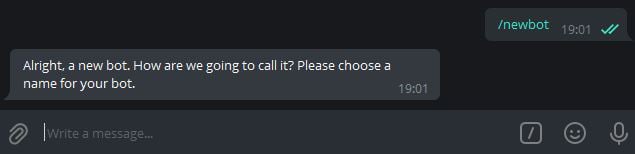
 *Source: [kitob-bot README](https://github.com/ytsshinobi/kitob-bot)*
When creation succeeds, BotFather sends a message containing your **token** (format like `123456789:ABCdefGHIjklMNOpqrsTUVwxyz`). Copy the full string.
Telegram documents this flow in the [Bot tutorial — Obtain your bot token](https://core.telegram.org/bots/tutorial#obtain-your-bot-token).
*Source: [kitob-bot README](https://github.com/ytsshinobi/kitob-bot)*
When creation succeeds, BotFather sends a message containing your **token** (format like `123456789:ABCdefGHIjklMNOpqrsTUVwxyz`). Copy the full string.
Telegram documents this flow in the [Bot tutorial — Obtain your bot token](https://core.telegram.org/bots/tutorial#obtain-your-bot-token).
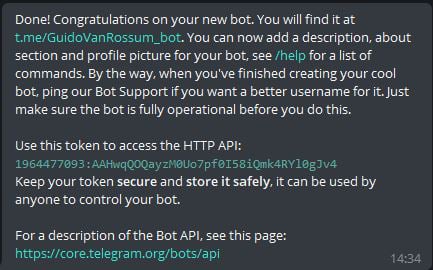 *Source: [kitob-bot README](https://github.com/ytsshinobi/kitob-bot). The token shown is from a public tutorial repo — treat your own token like a password.*
Treat the token like a password. If it is exposed, open BotFather and send `/revoke` for that bot, then paste the new token into Alter.
### Configuración opcional BotFather
| Command | When to use |
| ----------------- | --------------------------------------------------- |
| `/setdescription` | Short description users see before starting the bot |
| `/setabouttext` | About text on the bot profile |
| `/setuserpic` | Bot avatar |
| `/token` | Retrieve the token again for an existing bot |
## Paso 2: inicia un chat con tu bot
Tap the link BotFather provides (for example `t.me/YourBotName`) or search for your bot's username in Telegram. The success message in **Step 1** includes this link.
Send `/start` so Telegram opens a conversation. You need an active chat before testing Alter.
## Paso 3: Opcional: usar el bot en un grupo
Alter puede recibir mensajes de chats grupales y privados.
In your group, add the bot as a member (you may need admin permission to add bots).
By default, Telegram bots in groups may only see commands and @mentions. For broader group access, open [@BotFather](https://t.me/BotFather) → `/mybots` → your bot → **Bot Settings** → **Group Privacy** → **Turn off**.
See [Bot FAQ — privacy mode](https://core.telegram.org/bots/faq#what-messages-will-my-bot-get).
If the bot should only respond to certain people or groups, see [Secure access — allowlists and IDs](#secure-access--allowlists-and-ids) below and fill in **IDs de usuario o chat de Telegram permitidos** when you connect Alter.
## Acceso seguro: listas permitidas e ID
Restrinja quién puede usar su puerta de enlace Telegram con **IDs de usuario o chat de Telegram permitidos** en **Configuración → Integraciones → Gateways**. Alter compara cada mensaje entrante y cada pulsación de botón en línea con esa lista antes de ejecutar una acción.
Alter matches **user IDs**, **chat IDs**, and `@usernames` (case-insensitive). Leave the field **empty** to allow anyone who can message the bot. Enter `*` to allow everyone explicitly. Messages from users or chats not on the list are **silently ignored** — Alter does not reply with an error.
### ID de usuario versus ID de chat
Telegram utiliza ID numéricos tanto para personas como para conversaciones:
| ID type | Typical format | When to use in Alter |
| ----------- | -------------------------------------------------------------------------------------------------- | ------------------------------------------------- |
| **User ID** | Positive number (for example `123456789`) | Allow a specific person in DMs or in a group |
| **Chat ID** | Positive for private chats; **negative** for groups and supergroups (for example `-1001234567890`) | Allow an entire group, or a specific private chat |
En un **private chat** con su bot, la ID del chat suele ser la misma que su ID de usuario. En un **group**, agregue el ID de chat del grupo si desea que todos los miembros de ese grupo tengan permiso (sujeto a la configuración de [Group Privacy](#step-3--optional-use-the-bot-in-a-group)).
Alter también acepta valores `@username` (por ejemplo `@sam`) si la persona tiene un nombre de usuario público.
### Cómo encontrar su ID de usuario Telegram
In Telegram, open [@userinfobot](https://t.me/userinfobot) or [@getidsbot](https://t.me/getidsbot) and tap **Start**. The bot replies with your numeric **Id** — that is your **user ID**.
Copy the number (digits only, no `@`) into **IDs de usuario o chat de Telegram permitidos**.
To identify someone else, forward one of their messages to [@userinfobot](https://t.me/userinfobot) or [@getidsbot](https://t.me/getidsbot). The bot reports the sender's user ID.
Only forward messages in contexts where you are comfortable sharing metadata with a third-party bot. For sensitive groups, prefer the Bot API method below or add the whole group by chat ID instead.
### Cómo encontrar una ID de chat
Your user ID from **Step 1** above is usually enough — private chat IDs match the user's ID.
To confirm, message your bot, then call Telegram's [`getUpdates`](https://core.telegram.org/bots/api#getupdates) method with your bot token and look for `"chat": {"id": …}` and `"from": {"id": …}` in the JSON. See [Telegram Bot API — Chat](https://core.telegram.org/bots/api#chat) and [User](https://core.telegram.org/bots/api#user).
Add [@getidsbot](https://t.me/getidsbot) to the group temporarily (or use [@RawDataBot](https://t.me/RawDataBot)), send any message in the group, and copy the **Chat ID** from the bot's reply. Group IDs are negative numbers.
Remove the ID bot from the group when you are done if you do not need it there permanently.
With your bot token, open this URL in a browser (replace `TOKEN` with your token):
`https://api.telegram.org/botTOKEN/getUpdates`
Send a test message in the chat you want to identify, refresh the page, and read `message.chat.id` (chat ID) and `message.from.id` (sender user ID) from the latest entry.
Treat the URL like a password — anyone with it can control your bot. Close the tab when finished and never share the link.
Alter's `/status` command shows the default action and whether a conversation is selected — it does **not** print user or chat IDs. Use the methods above when building an allowlist.
### Configurar la lista de permitidos en Alter
Gather comma-separated user IDs, chat IDs, and/or `@usernames` for everyone (or every group) that should be able to use the bot.
Open **Configuración → Integraciones → Gateways**, edit your Telegram gateway, and enter the values in **IDs de usuario o chat de Telegram permitidos** (for example `123456789, -1001234567890, @sam`).
Click **Guardar y reiniciar**. Message the bot from an allowed account or group — you should get a reply. Messages from IDs not on the list are ignored with no response.
### Mejores prácticas de seguridad
* **Treat the bot token like a password.** Guárdelo únicamente en Alter (Keychain). Si se filtra, revocarlo en [@BotFather](https://t.me/BotFather) con `/revoke` y pegue el nuevo token en Alter.
* **Use an allowlist for personal bots.** Una lista de permitidos vacía significa que cualquiera que descubra su bot puede enviarle un mensaje mientras Alter se está ejecutando.
* **Prefer numeric IDs over `@username`.** Los nombres de usuario pueden cambiar; Las identificaciones numéricas son estables.
* **Limit group exposure.** Active [Group Privacy](#step-3--optional-use-the-bot-in-a-group) en BotFather a menos que el bot deba leer todos los mensajes del grupo. Agregue solo grupos confiables y incluya en la lista permitida la ID del chat grupal si el bot está en varios grupos.
* **Be cautious with third-party ID bots.** Pueden ver los mensajes reenviados y los metadatos del grupo. Elimínelos de grupos sensibles cuando ya no los necesite.
## Conéctate en Alter
Open **Configuración** (⌘,) → **Integraciones** → **Gateways**.
Click **Añadir gateway** → **Telegram**.
| Field | What to enter |
| ------------------------------------------------ | ----------------------------------------------------------------------------------------------------------------------------------------------- |
| **Nombre** | A label you will recognize (for example `Telegram — Personal`). |
| **Token del bot** | The token from BotFather (**Step 1**). |
| **IDs de usuario o chat de Telegram permitidos** | Comma-separated user IDs, chat IDs, or `@usernames`. Leave empty to allow anyone who can message the bot. Use `*` to allow everyone explicitly. |
**Ask Anything** es la predeterminada y funciona en Telegram de inmediato. Para una action personalizada, establece **Disponibilidad** en **Telegram** o **Todos** en **Action Editor → Gateways**.
Turn **Activado** on, then click **Guardar y reiniciar**. Wait for **Conectado como @your\_bot\_username**.
Si la conexión falla, consulte [Gateways troubleshooting](/apps-tools/gateways#troubleshooting).
## Prueba el robot
Gateways only work while Alter is open on your Mac.
In your Telegram chat with the bot, send `/help`. The bot should list commands.
Send a normal message. Alter should show **Thinking…**, then stream the reply. In private chats, Alter uses Telegram's native draft preview when available; otherwise it edits a regular message (rich replies can be up to about 32,000 characters).
Send `/help` and use the **New chat**, **Choose action**, or **Past chats** buttons. While Alter is responding in a group, tap **Stop** or send `/stop` to cancel the current turn.
Send a photo or document. Alter downloads supported attachments for the turn and can upload output files from tool runs when the action produces them.
Send a **voice message** or audio file. Alter transcribes it with your selected voice processor (**Configuración → Voice**) and sends the text to the active action. Audio-only messages work as chat turns even without typed text.
## Páginas relacionadas
* [Gateways overview](/apps-tools/gateways)
* [Set up a Discord gateway](/apps-tools/gateways-discord)
* [Alter Actions — Disponibilidad en Gateways](/workflows/alter-actions#gateways)
* [Alter Settings](/how-to/settings-guide)
*Source: [kitob-bot README](https://github.com/ytsshinobi/kitob-bot). The token shown is from a public tutorial repo — treat your own token like a password.*
Treat the token like a password. If it is exposed, open BotFather and send `/revoke` for that bot, then paste the new token into Alter.
### Configuración opcional BotFather
| Command | When to use |
| ----------------- | --------------------------------------------------- |
| `/setdescription` | Short description users see before starting the bot |
| `/setabouttext` | About text on the bot profile |
| `/setuserpic` | Bot avatar |
| `/token` | Retrieve the token again for an existing bot |
## Paso 2: inicia un chat con tu bot
Tap the link BotFather provides (for example `t.me/YourBotName`) or search for your bot's username in Telegram. The success message in **Step 1** includes this link.
Send `/start` so Telegram opens a conversation. You need an active chat before testing Alter.
## Paso 3: Opcional: usar el bot en un grupo
Alter puede recibir mensajes de chats grupales y privados.
In your group, add the bot as a member (you may need admin permission to add bots).
By default, Telegram bots in groups may only see commands and @mentions. For broader group access, open [@BotFather](https://t.me/BotFather) → `/mybots` → your bot → **Bot Settings** → **Group Privacy** → **Turn off**.
See [Bot FAQ — privacy mode](https://core.telegram.org/bots/faq#what-messages-will-my-bot-get).
If the bot should only respond to certain people or groups, see [Secure access — allowlists and IDs](#secure-access--allowlists-and-ids) below and fill in **IDs de usuario o chat de Telegram permitidos** when you connect Alter.
## Acceso seguro: listas permitidas e ID
Restrinja quién puede usar su puerta de enlace Telegram con **IDs de usuario o chat de Telegram permitidos** en **Configuración → Integraciones → Gateways**. Alter compara cada mensaje entrante y cada pulsación de botón en línea con esa lista antes de ejecutar una acción.
Alter matches **user IDs**, **chat IDs**, and `@usernames` (case-insensitive). Leave the field **empty** to allow anyone who can message the bot. Enter `*` to allow everyone explicitly. Messages from users or chats not on the list are **silently ignored** — Alter does not reply with an error.
### ID de usuario versus ID de chat
Telegram utiliza ID numéricos tanto para personas como para conversaciones:
| ID type | Typical format | When to use in Alter |
| ----------- | -------------------------------------------------------------------------------------------------- | ------------------------------------------------- |
| **User ID** | Positive number (for example `123456789`) | Allow a specific person in DMs or in a group |
| **Chat ID** | Positive for private chats; **negative** for groups and supergroups (for example `-1001234567890`) | Allow an entire group, or a specific private chat |
En un **private chat** con su bot, la ID del chat suele ser la misma que su ID de usuario. En un **group**, agregue el ID de chat del grupo si desea que todos los miembros de ese grupo tengan permiso (sujeto a la configuración de [Group Privacy](#step-3--optional-use-the-bot-in-a-group)).
Alter también acepta valores `@username` (por ejemplo `@sam`) si la persona tiene un nombre de usuario público.
### Cómo encontrar su ID de usuario Telegram
In Telegram, open [@userinfobot](https://t.me/userinfobot) or [@getidsbot](https://t.me/getidsbot) and tap **Start**. The bot replies with your numeric **Id** — that is your **user ID**.
Copy the number (digits only, no `@`) into **IDs de usuario o chat de Telegram permitidos**.
To identify someone else, forward one of their messages to [@userinfobot](https://t.me/userinfobot) or [@getidsbot](https://t.me/getidsbot). The bot reports the sender's user ID.
Only forward messages in contexts where you are comfortable sharing metadata with a third-party bot. For sensitive groups, prefer the Bot API method below or add the whole group by chat ID instead.
### Cómo encontrar una ID de chat
Your user ID from **Step 1** above is usually enough — private chat IDs match the user's ID.
To confirm, message your bot, then call Telegram's [`getUpdates`](https://core.telegram.org/bots/api#getupdates) method with your bot token and look for `"chat": {"id": …}` and `"from": {"id": …}` in the JSON. See [Telegram Bot API — Chat](https://core.telegram.org/bots/api#chat) and [User](https://core.telegram.org/bots/api#user).
Add [@getidsbot](https://t.me/getidsbot) to the group temporarily (or use [@RawDataBot](https://t.me/RawDataBot)), send any message in the group, and copy the **Chat ID** from the bot's reply. Group IDs are negative numbers.
Remove the ID bot from the group when you are done if you do not need it there permanently.
With your bot token, open this URL in a browser (replace `TOKEN` with your token):
`https://api.telegram.org/botTOKEN/getUpdates`
Send a test message in the chat you want to identify, refresh the page, and read `message.chat.id` (chat ID) and `message.from.id` (sender user ID) from the latest entry.
Treat the URL like a password — anyone with it can control your bot. Close the tab when finished and never share the link.
Alter's `/status` command shows the default action and whether a conversation is selected — it does **not** print user or chat IDs. Use the methods above when building an allowlist.
### Configurar la lista de permitidos en Alter
Gather comma-separated user IDs, chat IDs, and/or `@usernames` for everyone (or every group) that should be able to use the bot.
Open **Configuración → Integraciones → Gateways**, edit your Telegram gateway, and enter the values in **IDs de usuario o chat de Telegram permitidos** (for example `123456789, -1001234567890, @sam`).
Click **Guardar y reiniciar**. Message the bot from an allowed account or group — you should get a reply. Messages from IDs not on the list are ignored with no response.
### Mejores prácticas de seguridad
* **Treat the bot token like a password.** Guárdelo únicamente en Alter (Keychain). Si se filtra, revocarlo en [@BotFather](https://t.me/BotFather) con `/revoke` y pegue el nuevo token en Alter.
* **Use an allowlist for personal bots.** Una lista de permitidos vacía significa que cualquiera que descubra su bot puede enviarle un mensaje mientras Alter se está ejecutando.
* **Prefer numeric IDs over `@username`.** Los nombres de usuario pueden cambiar; Las identificaciones numéricas son estables.
* **Limit group exposure.** Active [Group Privacy](#step-3--optional-use-the-bot-in-a-group) en BotFather a menos que el bot deba leer todos los mensajes del grupo. Agregue solo grupos confiables y incluya en la lista permitida la ID del chat grupal si el bot está en varios grupos.
* **Be cautious with third-party ID bots.** Pueden ver los mensajes reenviados y los metadatos del grupo. Elimínelos de grupos sensibles cuando ya no los necesite.
## Conéctate en Alter
Open **Configuración** (⌘,) → **Integraciones** → **Gateways**.
Click **Añadir gateway** → **Telegram**.
| Field | What to enter |
| ------------------------------------------------ | ----------------------------------------------------------------------------------------------------------------------------------------------- |
| **Nombre** | A label you will recognize (for example `Telegram — Personal`). |
| **Token del bot** | The token from BotFather (**Step 1**). |
| **IDs de usuario o chat de Telegram permitidos** | Comma-separated user IDs, chat IDs, or `@usernames`. Leave empty to allow anyone who can message the bot. Use `*` to allow everyone explicitly. |
**Ask Anything** es la predeterminada y funciona en Telegram de inmediato. Para una action personalizada, establece **Disponibilidad** en **Telegram** o **Todos** en **Action Editor → Gateways**.
Turn **Activado** on, then click **Guardar y reiniciar**. Wait for **Conectado como @your\_bot\_username**.
Si la conexión falla, consulte [Gateways troubleshooting](/apps-tools/gateways#troubleshooting).
## Prueba el robot
Gateways only work while Alter is open on your Mac.
In your Telegram chat with the bot, send `/help`. The bot should list commands.
Send a normal message. Alter should show **Thinking…**, then stream the reply. In private chats, Alter uses Telegram's native draft preview when available; otherwise it edits a regular message (rich replies can be up to about 32,000 characters).
Send `/help` and use the **New chat**, **Choose action**, or **Past chats** buttons. While Alter is responding in a group, tap **Stop** or send `/stop` to cancel the current turn.
Send a photo or document. Alter downloads supported attachments for the turn and can upload output files from tool runs when the action produces them.
Send a **voice message** or audio file. Alter transcribes it with your selected voice processor (**Configuración → Voice**) and sends the text to the active action. Audio-only messages work as chat turns even without typed text.
## Páginas relacionadas
* [Gateways overview](/apps-tools/gateways)
* [Set up a Discord gateway](/apps-tools/gateways-discord)
* [Alter Actions — Disponibilidad en Gateways](/workflows/alter-actions#gateways)
* [Alter Settings](/how-to/settings-guide)